Wednesday, March 20, 2013

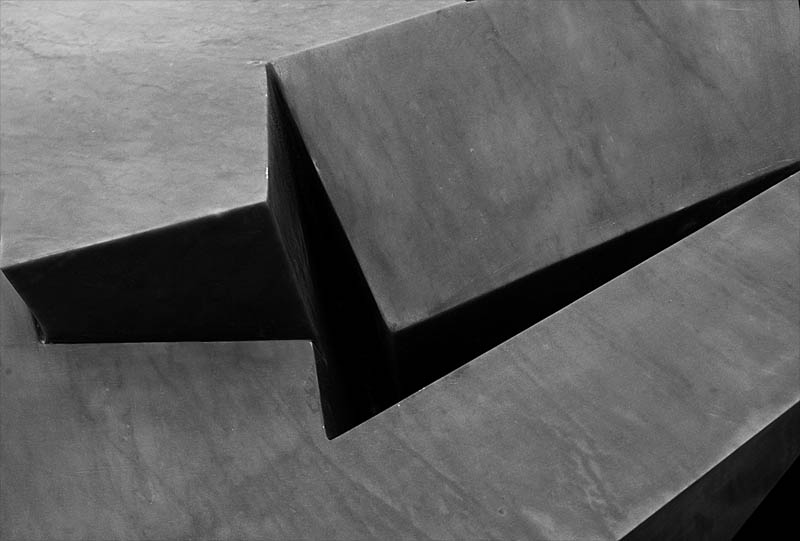
ZIG ZAG


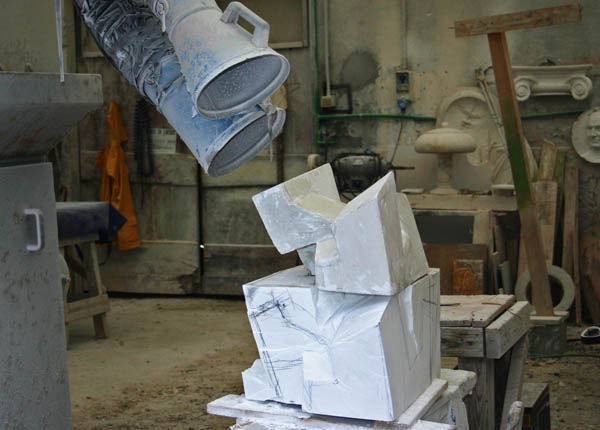
I have finally finished the sculpture in Bardiglio I started at the end of November

Early stages


Tuesday, January 1, 2013

STAN TRACEY

Photo by Pino Ninfa
Two days ago I attended a performance at The Bulls Head in Barnes given by Stan Tracey to celebrated his 86th birthday.  There was absolutely no sense of it being a “noble effort for a man of that age” it was a performance by a man  still completely in charge of his considerable creative powers.

Stan Tracey has been the pivotal figure in British modern jazz for 6 decades. His dedication to making music and his total refusal to compromise his creativity in any way has been an inspiration to generations of musicians.  


 Last New Year he was here in Italy performing at The Umbria Winter Jazz Festival in Orvieto and then again in the Summer sharing a stage with Herbie Hancock.  But whether playing to large venues or a small British pub for Stan it is just another chance to create music. Which he does with own unique blending of harmony and rhythmic line that is impossible to hear for more than 3 seconds without recognising it as his. It may have  influences of Monk and Ellington but you would never mistake it for either.


I first heard heard him at Ronnie Scott's club in soho in the late sixties when he was the support act for Archie Shepp. I was then a student and completely taken in by the myth that only black Americans can play jazz, for me Shepp was where it was at,  with his black power politics and free form aggressive sounds, the white Englishman playing solo piano in between sets was largely ignored be me and many others.
Archie Shepp in Vicenza
Stan Tracey in Italy
  A few years ago at the Vicenza Jazz festival I had again the opportunity to hear both musicians at the same event, the black power activist had by now become a predictable all round entertainer and Stan was as uncompromisingly creative as ever.  The myth completely destroyed.  A myth that has blighted British jazz musicians for decades.

After my student days I rarely listened to jazz until by chance I went to a concert in Kendal, Cumbria where Stan was performing with John Surman.

 I was so impressed that subsequently whenever I was in London I sought him out and soon became hooked on the British modern jazz scene, eventually booking Stan’s quartet to play at my home in Appleby, Cumbria. An event that grew into an 18 year annual jazz festival. Stan Tracey performed at every one of those festivals.


I have always felt  his playing to be sculptural and that he uses space in a similar way to a sculptor.  Space in sculpture can become an entity itself when defined by the weight of the forms around it. Stan creates solid phrases of structured sound that weave  in, out and around solid spaces.

Photo by Pino Ninfa

 Stan is an inspiration to all creative artists, by his own admission he is a hermit, he hides away between gigs and shuns social events (though he did come out of hiding to receive both his O.B.E and his C.B.E}. He doesn’t take work as a pianist in other musicians' bands, he doesn't write or perform in advertising jingles. He has his own vision of music which he has dedicated a whole life to perfecting, without deviation.

In the words of pianist Keith Tippet “Stan Tracey  is the Master”.


Saturday, December 15, 2012

A Stroll Along The Thames


Though I have never seriously lived in London  it has all ways been a part of my life and now that I live abroad visiting London becomes a nostalgia trip revisiting old haunts. West London with the Thames meandering through several large parks has always been a favourite one.

Last weekend I took a stroll from Hammersmith bridge along the river to Barnes. To feed the desire for nostalgia a pint in the Dove at Hammersmith was essential, even though it was only 11am.


The river passes alongside the Fullers Brewery and  Hogarth House and on to Chiswick Old Cemetery famous for its  rather boring monument  to Hogarth situated right next to the church of St Nicholas. 


  Few people realise that in the far reaches of this graveyard against a wall lies a sarcophagus containing the remains of  a painter much more to my taste - James McNeil Whistler.


The message bronze plaque near the sarcophagus is a sad comment on our age. 


The four bronzes survived 60 years before finally being stolen but when replaced in our time didn’t even last a year. I am sure if they had been in Italy they would still be there. While like most Europeans the Italians don’t really have much time for art or religion in their daily  lives they still hold a deeply rooted reverence and respect for both. 


After paying my respects to Whistler I strolled on along the river to a place that was truly life changing for me 25 years ago -  the Bulls Head, Barnes.  It was here listening to musicians such as Stan Tracey, Peter King and Don Weller that I fell in love with British jazz, an obsession that initiated  the  creation of  The Appleby Jazz festival in Cumbria which incrementally took over my life for 18 years.


Though I no longer function as a jazz promoter I try and catch up with the musicians and the music when in London and the day before my stroll down the Thames I had travelled down to Dorset with Alan Barnes to attend a concert he was performing with Don Weller and Art Themen.


And the day after I spent a very pleasant afternoon in the Princess of Wales, Primrose Hill listening to Art Themen. The immense quality of British jazz has never received its true appreciation - but that is for another blog.  Meanwhile here is a taste.


Friday, November 30, 2012

Kandinsky Exhibition in Pisa

We took a train ride to Pisa to visit the Kandinsky Exhibition .


It focused on his work up to the early 1920's.and highlighted the influence of Russian folk art and his connection to other Russian painters of the time. It was a fascinating exhibition and an opportunity to see many paintings I have not seen before.  


 The vibrance of the colour even after nearly 100 years was fantastic and it seemed  that whether painting totally abtract or in representational mode which he did at the same time he produced very good paintings. It seems that right from the beginning he grasped the essential fact that painting is about coloured pigment on canvas.


Alongside the Kandinskies were paintings by many other Russian artists of the period none of whom I had ever heard of and it gave you the impression that pre World War One Russia was where modern art really started,  and while the English were suffering the Pre-Raphaelitism and other  victoriana, and protesting about the decadence of post Impressionism the Russians were exploding with great energy, exploring ideas that were breaking free from the stagnation that  European art had got into. 
It could be that many Russian painters were still so connected to their history of folk art and Icon painting that  releasing  the grip of purely representational painting came easier to them.


The  painting above by  Mikhail Vrubel, was painted in 1901.He was a  painter of amazing abilty whose total individuality has meant his exclusion from being  included in the story of the progression of modern art.


He died in a Mental hospital in 1910 aged of 54.

Another Russian painter that impressed me was.


Unfortunately the exhibition ended with the start of Kandinsky's Bauhaus years, where his work began to have more well defined boundaries.

The exhibition is on until February and I firmly intend to revisit before it ends.


Pisa was also a visual  delight as usual.


Tuesday, November 27, 2012

A Four Piece Sculpture in White Marble

Still waiting for the new marble to be delivered to the studio, this is Italy, things happen when they happen.
I crated up my last piece, which was constructed with 4 interlocking pieces of marble. Taking it apart and reassembling is risky as marble is so easily damaged, so it will now stay crated until exhibited, whenever that might be.
This a photo of the clay original, which is only about 25cms high. 

From this I used  sheet plaster to construct a copy with all dimensions doubled.

 We had fun collecting the half ton piece of greek marble.

 It was cut into blocks.

 I proceeded to copy each gesso piece into marble,  with two extractors sucking away the dust.


 A block and tackle was essential to safely fit the pieces together.

 First fitting.

 The finished sculpture