Friday, April 11, 2014

MOVEMENT & THREE NORWEGIAN SCULPTORS


The Vigeland sculpture park in Oslo
Whenever you ask someone what there is to see in Oslo they say Edvard Munch and the Gustav Vigeland Sculpture Park. Never having heard of Gustav Vigeland I became keen to visit when I read that he is hailed as Norway’s greatest sculptor and was compared to Michelangelo in his day.


 The large park  houses over 200 pieces of his work and boasts to be the largest sculpture park containing the work of a single artist in the world.  Indeed the whole thing is quite amazing, even more amazing is that he got the town to pay for it all. The bill for the carving of granite and casting of bronze  must have amounted to millions of kroner. His involvement would have been in producing all the models for an army of artisans to make and overseeing the placement of the work. These days a sculptor is doing well if he can get a town to commission just one piece of public sculpture..

One of the bronze statues by Gustav Vigeland.

But to the puzzlement of my Norwegian friend who had taken me there, I couldn’t  get really excited about the work. Had these been new sculptures by  Michelangelo or Giambologna I would have had to camp out in the park for weeks to see them all,  but sadly I soon became a little tired of them, something was missing, not imaginative composition as there were sculptures of people in every possible combination of interesting poses,  he was obviously a very honest and committed sculptor.  My guide asked me what I thought and I couldn’t really explain why I wasn’t excited by the work.


The word that kept coming to mind was “static”,  for me the sculptures seemed not to have any real sculptural movement in them yet they depicted human beings involved in all sorts of activities. It made me think about the element of movement in sculpture. As sculpture is by very nature static, it doesn’t move itself, the depiction of a moving human being has to be done using the sculptural language, it is illusory. When this is done well it gives a sculpture a feeling of energy and vitality.

I had visited the  National Gallery of Norway the day before and looked  again at some small sculptures by Degas and one by Rodin  that always excite me.

These two sculptors had their own different ways own way of creating a sense of movement, for example Rodin’s work which is strong on sculptural movement,  creates tension by depicting the exact moment when movement is about to start and we complete the movement in our imagination. Just to portray someone running by spreading the legs into a running position doesn’t convey the feeling of movement.

The Rodin sculpture (left) looks as if the man is about to either fall or drop
the other person, while in the Vigeland the man is firmly planted on the
ground  and seems quite capable of supporting the other person.
Iris by August Rodin

Degas,  accepts that a sculpture itself is static but he magically  manipulates the profile lines to make it appear to move as the viewer moves around it.
Summing up I feel that Vigeland often leads you to expect this element of movement through his choice subject matter but he doesn’t deliver,  relying instead on the expression of the story of the human predicament to carry everything.

The next day I visited an exhibition of a more recent Norwegian sculptor  Aase Texmon Rygh who was born in 1925.

The exhibition of Aase Texmon Rygh
 Her answer to the problem of movement was to base nearly every sculpture on “The Mobius Strip” a surface with only one side and only one boundary component.

Mobius strip sculpture
 The problem with movement using this form is that it is always the same, you know exactly what is coming as you go around the object, there are no surprises, little tension and ultimately it can be rather boring.  It is a form that has been exhausted by the Swiss designer Max Bill in the 40's and 50's, who does manage to raise it to a higher level.
Its equivalent in music might be the “12 Bar Blues” a predictable and comfortable musical form, you always know where it is going and it gives pleasure when it gets there.


I was in Norway to attend the opening of an exhibition of another Norwegian artist Julia Vance.

Drawing by Julia Vance

She is a calligrapher and sculptor whose approach to movement comes from her training as a calligrapher.  The sense of movement in writing performed with a wide brush comes from the natural widening and narrowing of the marks as the brush turns corners.

Marble sculpture by Julia Vance
Julia sometimes uses this approach in her sculpture, narrowing and widening a form to give a sense of movement. The art comes in the creators sensitivity to the moving line, which I find really strong in her work
.
Marble sculpture by Julia Vance
I feel there is also a constant searching and development in her work, unlike the other two sculptors who both  found formulas to produce work and were prone to repeat them 'ad infinitum'.  

The exhibition of Julia Vance.


Monday, March 31, 2014

Trieste and the Palazzo Revoltella


Trieste from the Palazzo Revoltella


The great thing about visiting new places is the opportunity it affords to check out the art galleries for artists whose work is unfamiliar to you.

The Palazzo Revoltella

I have just been to Trieste and visited the Palazzo Revoltella. Which was once the home of  local importer, financier and politician  Pasquale Revoltella. He bequeathed his palazzo to the commune of Trieste and with it a huge sum of money  with instructions that they build and house an art collection. 
The modern art gallery in Palazzo Revoltella
Since then it has grown into a substantial gallery of late 19th century and 20th century art.
Pasquale Revoltella

 Pasquale became very much involved in the building of the Suez canal, obviously seeing the commercial benefits of it , but died just a month before it opened. Despite being unspeakably wealthy he never married, which may explain the large numbers of paintings of woman’s cleavages that adorned his walls. 

The early version of Playboy magazine.
Before the days of photography and the internet, wealthy men could afford to employ painters to give them pleasing images of the female form
The dining room in Palazzo Revolterra


One painting that intrigued me was  this one  ironically named The Holy Water
by an Austrian painter who I had never heard of called Albin Egger-Lienz (1868-1926)  . 
The Holy Water by Albin Egger-Lienz

 Its unusual and  powerful composition caught my eye immediately, so later  via the wonders of the internet  I managed to find more images of his work.


He was commissioned as a war artist in 1914
The skilful interweaving of the lines in this painting make for a very tight composition while the paring down of detail and colour towards abstraction heighten the expressive quality. You can feel the horror of these men’s predicament.

Albin Egger-Lienz ( a rather serious looking gentleman)
Resting Shepherds by Albin Egger-Lienz

The Sower  by Jean Francoise Millet

His paintings of  rural life owe a lot to Jean-François Millet, but his compositional talents are all his own.
Hardtimes by Albin Egger-Lienz

In the modern sculpture room I found this delightful small sculpture 
Homage, 1963, steel, cm 70x65 by Dino Basaldella
It was so full of lovely lines and  intuitive sculptural ideas I wanted to steal it

Again on the internet I found that he was one of 3 artist brothers, Dino, Mirko and Afro, the later becoming the most  well known of the three. 

by Afro Basaldella
by Mirko Basaldella


All three were working through the 40's, 50's and 60's all exploring the visual language and producing work of high quality.  I have begun to notice that whenever  I am wandering through a gallery and  something catches my eye from a distance as something of quality and  I go over and check it out,  it more often than not turns out to be pre 1970.
Does this mean that my taste is stuck those years or that very little since then is of quality? How would I know?


Thursday, January 23, 2014

Wow! Another Large Bronze


Again a single piece of public art placed in the Piazza has started a train of thought about sculpture and public art. The piece is again  a large bronze, this time of a fantasy hunting scene.


Impressive it certainly is, the fantasy and representational  aspects of the work do not interest me much and it is only really strong in design from two viewpoints but the work interested me enough to find out more  about the artist. His name is Dashi Namdakov and he comes from a remote region of Russia called Trans Baikal an area sandwiched between Mongolia and Siberia.


He has recently become a megastar in the international art world, but unlike many over-hyped art megastars with little talent  this artist has graphic talent in bucket loads, not only does he sculpt on large and small scale he also makes jewellery, designs buildings and much more. I would be quite happy if I had one tenth of his natural talent. It is easy to see why he has become so popular, he has wow! factor – you don’t have to search his sculptures – they hit you immediately.


I have been thinking a lot recently about how most art today strives for this sort of appeal. The art audience want to walk around a gallery receiving instant hits from the art; rarely does anyone spend an hour looking at a painting or sculpture and most modern art of today would start to bore you after 5 minutes.

Art critic Robert Hughes
I recently watched a documentary by the art critic Robert Hughes called “The Mona Lisa Curse” which is essential viewing for any artist of today. I quote:

“We have had a gutful of fast art and fast food. What we need is slow art, art that grows out of modes of perception and making, whose skill and doggedness makes you think and feel. Art that isn’t merely sensational, that doesn’t get its message across in 10 seconds, that isn’t falsely iconic but art that hooks onto something deep running in our natures.”

I am not trying to belittle Namdakov’s huge talent but if I had to choose between one of his fantastic animal sculptures and Picasso’s goat sculpture, the goat would win every time.

Picasso's Goat sculpture

When it comes to line, for me Picasso is the great master of our age, when I see that film of Picasso painting and he starts with a few simple lines down the canvas the hairs on my neck stand up.


Undoubtedly Namdakov has a great graphic sense of line but for me it is often slick and sometimes even sickly and  it is not coming from the same place as it is with Picasso.

Horse by Namdakov

Bronze by Dashi Namdakov


Monday, July 22, 2013

A MOMENT OF VIOLENCE


The Piazza, Pietrasanta

Having enjoyed over a week of the beautiful Pietrasanta Piazza being free of obstructions, I took a seat in my favourite bar, looked up and found that a  gigantic 16 foot bronze statue was obscuring my view of  Sant' Agostino. I breathed a sigh of resignation and thought “What now?”


It turned out to be a monumental sculpture of the moment when French footballer Zidane head-butted an Italian opponent because he was taunting him. The sculptor is Adel Abdessemed,  a conceptual artist who lives and works in Paris.

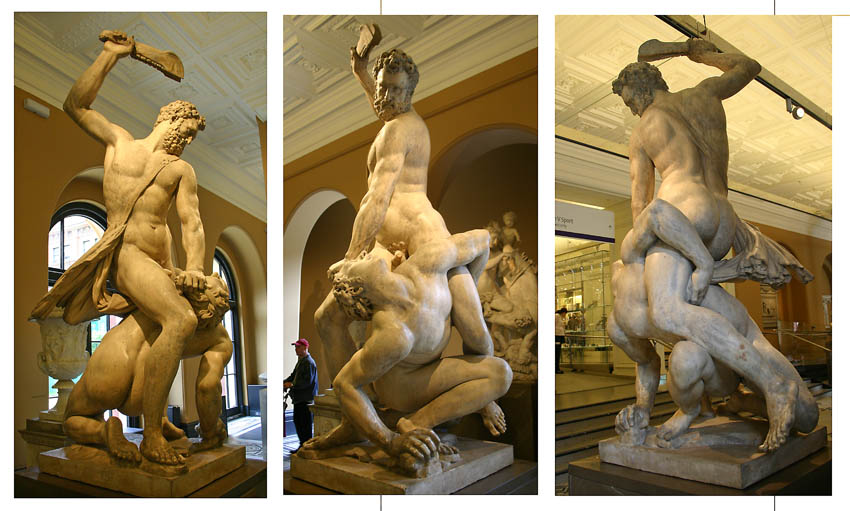
Samson Slaying a Philistine

 The subject of violence is certainly not new in art.

There is a large marble sculpture by Giambologna (John from Bologna) called Samson Slaying a Philistine. Samson apparently was taunted by the  philistines so he set about slaying a few thousand of them with an ass's jawbone.

It was commissioned in about 1562, by Francesco de Medici for a fountain in Florence, and later it was gifted  to Spain. Then in 1623 it was given to the  Prince of Wales, later to become King Charles I, while he was in Spain negotiating a marriage contract, and it soon became the most famous Italian sculpture in England and is now  the centre piece of the sculpture collection in the V&A Museum in London.

The sculpture is a perfect example of 3 dimensional form that offers no front and back views, but continually shifting  lines and forms that change as you circle it. View it as many times as you like - it will always surprise you.


 I could bore you for ages talking about the sculptural merits of the Samson against the lack of them in the Zidane, but I think the juxtaposition of the photos above says it all. The control of the sculptural language in the Giambolgna is in the sphere of genius while it's questionable that there is even a smattering of mediocre talent in the Abdessemed sculpture.

Adel Abdessemed
The Zidane sculpture  is conceptual art, it is not interested in the traditional lanquage of sculpture, but the question arises " why is it so large, in traditional bronze and in an historic Italian Piazza?"

Another work by  Adel Abdessemed
It might seem unfair to compare the Zidane work with a masterpiece from the Renaissance, like comparing a tv script for a soap opera with a Shakespeare play. One is pop culture; one is high art and everyone can choose what they want to engage with.  I have no objection to people enjoying Adel  Abdessemed 's work in a gallery,  I can choose not to go,  but this monument to ego is large, impossible not to see and blocking my view of Sant' Agostino.

Where is the Samson and his  jaw bone today, when you need him?


Wednesday, July 10, 2013

Pietrasanta Sculpture

The Comune of Pietrasanta advertise the town as Citta d’Arte. For centuries it was the Italian centre for carving and casting religious art. The skills for this can still be found with  the artisans who live and work here today.  As the demand for religious art declined modern artists started to come here to have work cast in bronze or carved in Marble, 40 years ago you might have bumped  into Henry Moore, Jacques Lipchitz or Noguchi in the town.  The town was then a working town, studio space and living accommodation was cheap and few tourists visited.
When I first visited 12 years ago it was already in decline as a working town, since then the decline has continued rapidly.  The Comune has had a policy of forcing the small marble studios to move out of town and allowing development of the empty properties.
As the population of artists decreases the tourist population increases and today in summer almost every property in the main streets of the town becomes either a  restaurant or a chic art gallery.

The Piazza, Pietrasanta, Tuscany, Italy
It has one of the most beautiful Piazzas in the whole of Italy.  Through a collaboration of the Comune and gallery owners the Piazza hosts exhibitions of  large pieces of sculpture by well known sculptors throughout the year.
Currently in the Piazza is an exhibition of work by well known sculptors that has been made in the town by the studios. .


Igor Mitoraj

The new Mitoraj above the main door of San Agostino
There has been a very hot debate here lately between the Comune who allowed Mitoraj to make a sculpture for the tympanum above the main door to the church of San Agostino and many of the art community who felt it to be sacrilegious. My signature was among the 1300 on a petition against it. I imagined it might be one of his giant hollow faces, but when it was unveiled last weekend it turned out to be quite innocuous and barely noticeable and is a rather a weak affair compared to most of the great art that has decorated tympanums over the centuries.

A Close up of the new work by Mitoraj

A fallen angel by Igor Mitoraj
 I am afraid I find Mitoraj's nostalgic fake antiquities have a built in sterility. There is nothing about them other than their sense of presence, which admittedly can be very strong, but there is no real engagement with the language of sculpture, nothing to excite me in the way that a simple line of Picasso or a space in a Chilida sculpture can.


Fernando Botero

A sculpture by  Fernando Botero


Fernando Botero is a very well known sculptor everywhere except England. At any time of the year there is hardly a foundry in the town that is not casting and finishing one of his large pieces, his works sell all over the world, for large sums of money and this industry keeps many of the towns foundries in work. Personally I consider the sculptural quality of his work rather poor, and feel that once you have seen one Bottero you have seen them all, there seems very little development in his ideas.

Jimenez Deredia 

A sculpture by Jimenez Deredia
Another sculptor is the Costa Rican Jimenez Deredia, who also tends to use very bulbous forms, which like Bottero offer rather boring linear profiles lacking in tension and giving poor relationships of the various masses.


Rabarama
A sculpture by Rabarama

Rabarama, is a very successful female Italian sculptor with large figurative works that can be found in cities all over the world.  The following is a quote from her very slick website
“The artist’s subjects mostly have absent gazes, blanked out by crystallized research which is conditioned by a world governed purely by cause-effect relationships, whose common denominator is the standardized programming of the species”
There you have it!!!

What all these sculptors have in common is that they have their work made in Pietrasanta by an army of highly skilled artisans. But for me  there is more to sculpture than just techniques and skill and I love to see work that explores, that tries to push the boundaries of the sculptural language. One person’s honest struggle with ideas of form, line, planes, space and masses is much more exciting than all the grand gesturing of these large sculptures.


 Kan Yasuda - Chiave del Sogno
Here is one that I do like. I love the contrast of the loosely flowing outer line with the tightness of the inner line and the very subtleway it sits on the ground.